


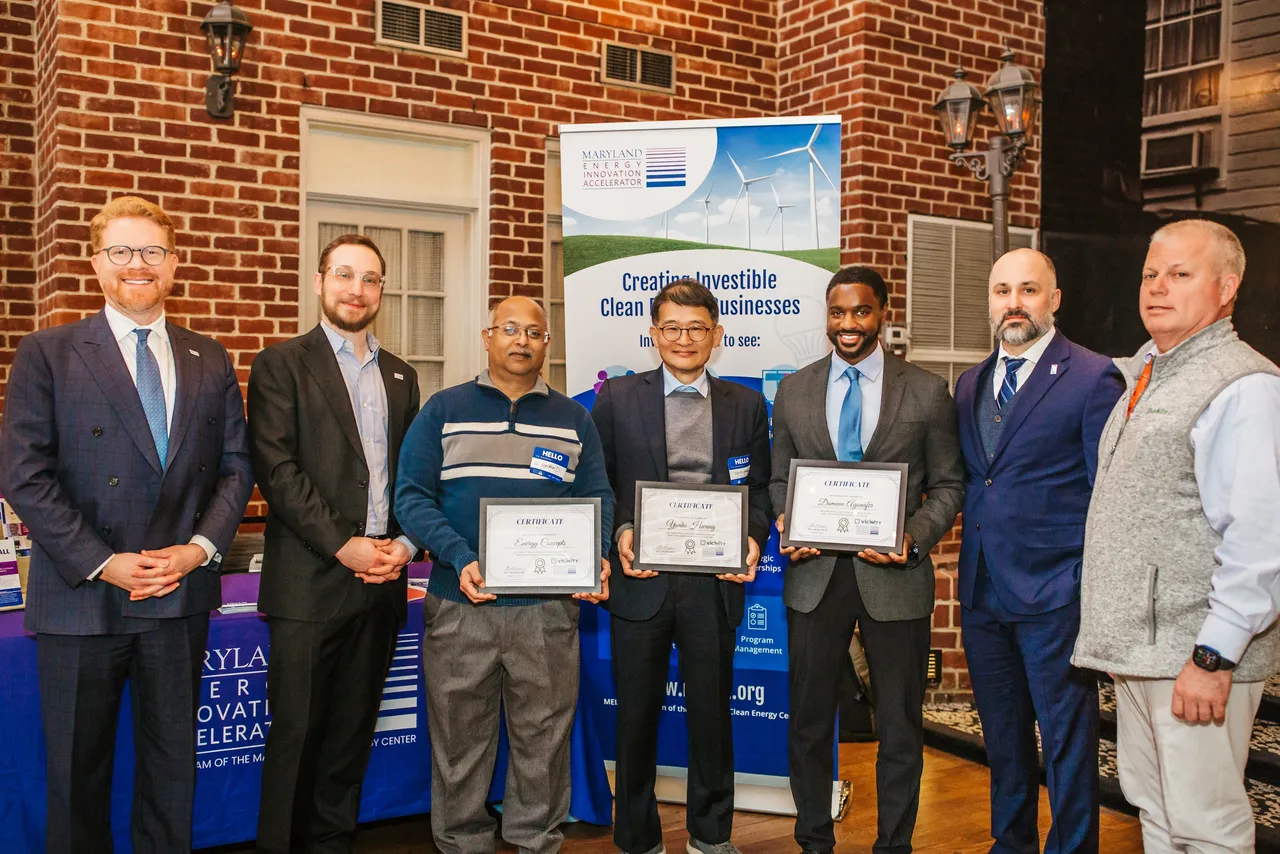
On Friday, February 6, Vicinity Energy and the Maryland Energy Innovation Accelerator (MEIA) officially wrapped our Ideation Program Finale — the culmination of a multi-session innovation sprint designed to fast-track real-world decarbonization solutions. This wasn’t just a pitch competition. It was a hands-on, operator-led collaboration built to accelerate technical concepts into viable pilots, partnerships, and long-term deployment pathways.
Over several months, participating teams worked directly with MEIA and technical experts from Vicinity Energy to refine concepts across electric boilers, heat pumps, thermal energy storage, and district energy system integration.
Instead of innovating in isolation, teams engaged with an actual utility operator, pressure-testing ideas against real infrastructure constraints, real customer needs, and real deployment pathways. When operators and innovators sit at the same table, you skip months of guessing and get straight to what matters. That’s how promising ideas turn into deployable solutions.
After multiple stages of collaboration, five teams advanced to deliver their final presentations at the Ideation Finale. We were honored to be joined by Maryland leaders championing climate innovation, including Marc Korman, Chair of the House Environment & Transportation Committee; Michele Guyton, Vice Chair; Kevin Hagerty, CEO of Vicinity Energy; and Jenn Aiosa of the Maryland Energy Administration. Their presence reinforced a clear message: Maryland is serious about advancing practical, scalable climate innovation.
We closed the program by recognizing three standout teams selected from the five finalists who presented at the Ideation Finale.
First Place was awarded to Damena Agonafer, University of Maryland Professor. His team developed an innovative approach to capturing waste heat directly from data centers and converting it into usable thermal energy for district systems. By using a liquid coolant that boils directly on computer chips to generate higher-temperature heat at the source, the system reduces the need for energy-intensive heat pumps downstream. The concept reimagines data centers not just as energy consumers, but as potential community heating assets — a systems-level solution that strongly resonated with Vicinity’s technical team.
Second Place was awarded to Yunho Hwang, Research Professor, University of Maryland, and Third Place was awarded to G. Anand, Director of Technology, Energy Concepts. Both teams showcased advanced solutions aimed at strengthening district energy electrification and system optimization. From next-generation heat pump innovation to integrated system strategies, their work demonstrated strong technical depth and clear applicability to real-world utility operations. Together with the two additional finalist teams, they elevated the conversation around what scalable thermal decarbonization can look like in Maryland and beyond.
A sincere thank you to all of the teams who stepped up to tackle this challenge, and to the attendees, mentors, and partners who showed up to support them. The level of thoughtfulness, technical rigor, and creativity on display made it clear that Maryland’s innovators are building serious solutions.
When operators like Vicinity open their doors to early-stage companies and entrepreneurs are willing to test their technologies in real-world settings, ideas move faster from concept to implementation. That kind of partnership accelerates everyone involved and reflects the kind of ecosystem we are proud to help cultivate.
To learn more about how Maryland Energy Innovation Accelerator supports climate technology founders, or to explore partnership opportunities with Vicinity Energy, we encourage you to connect with our teams and stay engaged in the growing climate innovation ecosystem here in Maryland.